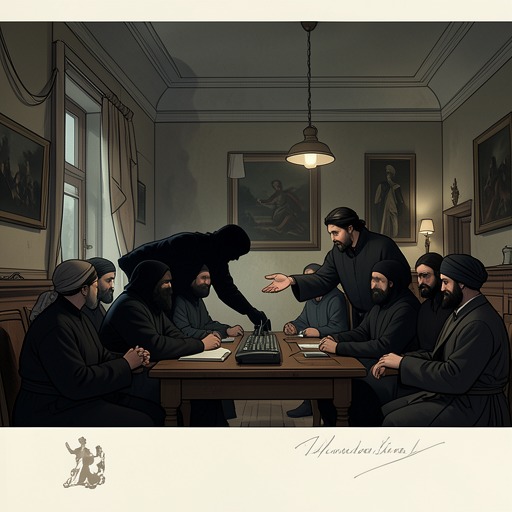
Tableau de l'inconstance des mauvais anges
The Pale Blue EyeTableau de l'inconstance des mauvais anges is a massive French volume by the witch hunter Pierre de Lancre, encountered in Professor Pawpaw’s library and read by Edgar Allan Poe during the investigation of Leroy Fry’s death. Its graphic account of a witches’ Sabbath names the hearts of hanged men among the feast’s contents, bringing the murder’s missing heart into a religious and occult frame. The book does not prove who killed Fry or what rite, if any, took place; its force lies in furnishing the investigators with a specific image and a way to read the traces they seek.
The Volume and Its Setting
The book emerges from a library that seems almost made of books. Professor Pawpaw’s windowless room is only about a dozen feet in either direction, yet folios, quartos, and parchment-covered duodecimos fill it: piled on shelves and floor, some still open to the pages last consulted. Pawpaw climbs the shelving to retrieve his chosen volume, a massive book bound in black leather and fastened with silver clasps. When he pats it, dust rises through his fingers. Its weight, worn surface, and place among the professor’s accumulated reading make it a physical repository of older accounts of witchcraft, not merely a title invoked in conversation.
Pawpaw identifies the work as Pierre de Lancre’s Tableau de l'inconstance des mauvais anges. He describes de Lancre as a formidable witch hunter who found and executed six hundred Basque witches over four months, and calls the resulting volume remarkable. That history places the text at an uneasy intersection: it preserves a learned account of alleged demonic practice, but its author’s authority is also inseparable from the violence of persecution. The book’s descriptions reach the investigators through a record made by someone who claimed to uncover and punish witches.
Poe’s Reading and the Sabbath Image
Poe reads French and begins to examine the volume while Landor and Pawpaw talk nearby. When Pawpaw suggests checking the young reader’s progress, Poe has remained so still that dust has settled on his shoulders. He is absorbed in an engraving spread across both pages: a feast populated by hags astride hairy rams, demons carrying living babies, bonneted skeletons, and dancing fiends. At its center sits a goat in a golden chair, fire issuing from its horns. The scene turns the book’s subject into a spectacle of grotesque abundance, organized around a commanding figure and surrounded by creatures and bodies in motion.
Poe asks permission to read aloud from a section describing the witches’ Sabbath. He warns that he is still translating and stumbles over the passage, which lists unclean animals and then names the hearts of unbaptized children and the hearts of hanged men among the feast’s contents. The last detail changes the temperature of the investigation. Fry was hanged, and his heart was taken from his body; the book’s inventory therefore offers a precise, macabre parallel to the crime. Poe looks from Pawpaw to Landor and grins as the correspondence lands. The text supplies an interpretive possibility, not a demonstrated connection between de Lancre’s account and Fry’s killer.
From Religious Premise to Physical Clues
The book enters an investigation already turning toward religion. Landor recalls that Poe had connected the taking of Fry’s heart with the Bible, while Landor himself had begun to wonder whether the crime bore some religious character. Their working premise arises from Fry’s earlier association with a disreputable group and his subsequent entry into the Prayer Squad; Sylvanus Thayer, on seeing Fry’s body, had also thought of a religious fanatic. De Lancre’s account gives that broad suspicion a more particular vocabulary of rite and ceremonial objects.
Landor’s reasoning shifts from what a perpetrator might have used to what the scene might retain. If stones, candles, or other objects had been deliberately arranged for a ceremony, the killer could remove them afterward. Their impressions in the ground, however, might persist longer, especially given the limited time before a search party arrived and the need to dispose of Fry’s heart. The book thus helps prompt a practical question: rather than expect the ritual objects to remain, the investigators should look for the marks left by objects that are gone. Its narrative value lies partly in this movement from horrifying description to a method of searching for material evidence.
Ritual, Order, and the Book’s Limits
The book’s imagery resonates with other scenes of ordered collective action at the United States Military Academy, though the forms of order are sharply different. At evening parade, the cadets assemble in companies, their movements governed by commands and drill. Fry’s place in the ranks has already been filled, so the formation appears able to absorb his absence; only a trained observer might catch a lost step or half shuffle. Against that public discipline, de Lancre’s account offers a secret gathering defined by an illicit feast and demonic figures. The contrast does not establish that the Academy’s ceremonies and the alleged Sabbath are equivalent. It instead sharpens the novel’s interest in how ritual organizes bodies, assigns places, and can conceal what is missing.
Later, Landor discovers a hidden room arranged with rows of blazing tapers, a circle of torches, and a triangle of candles, with a brazier and a burning pine tree adding to the fire. These details make the earlier search for ritual traces newly consequential: deliberate arrangements of flame and geometric forms do exist in the story’s concealed ceremonial space. The scene recalls the investigators’ concern with candles and intentional placement, but the evidence does not establish that de Lancre’s book dictated the later arrangement or that every feature of the room derives from the volume. The distinction matters: the book guides attention and supplies a parallel, while the physical scene must still be read on its own terms.
Narrative Significance
Tableau de l'inconstance des mauvais anges is both an object and an interpretive instrument. Its silver clasps, black binding, dust, crowded library setting, and large engraving give the investigation a tangible encounter with a written tradition of demonology. Its passage about hanged men’s hearts then makes Fry’s mutilation legible within that tradition, even as the book’s association with a witch hunter cautions against treating its claims as neutral fact.
The volume also marks a change in the investigation’s scale. The stolen heart is no longer considered only as a bodily injury or an isolated clue; Landor and Poe test whether it belongs to a ceremony whose traces might survive the removal of its implements. The book cannot answer who acted, establish the killer’s motive, or verify that the crime reproduced the Sabbath it describes. It does something more limited and more useful: it furnishes a pattern that the investigators can compare with the material world, where the distinction between an absent object and its remaining impression may matter most.